

Hi Hostage! Time for the Payment

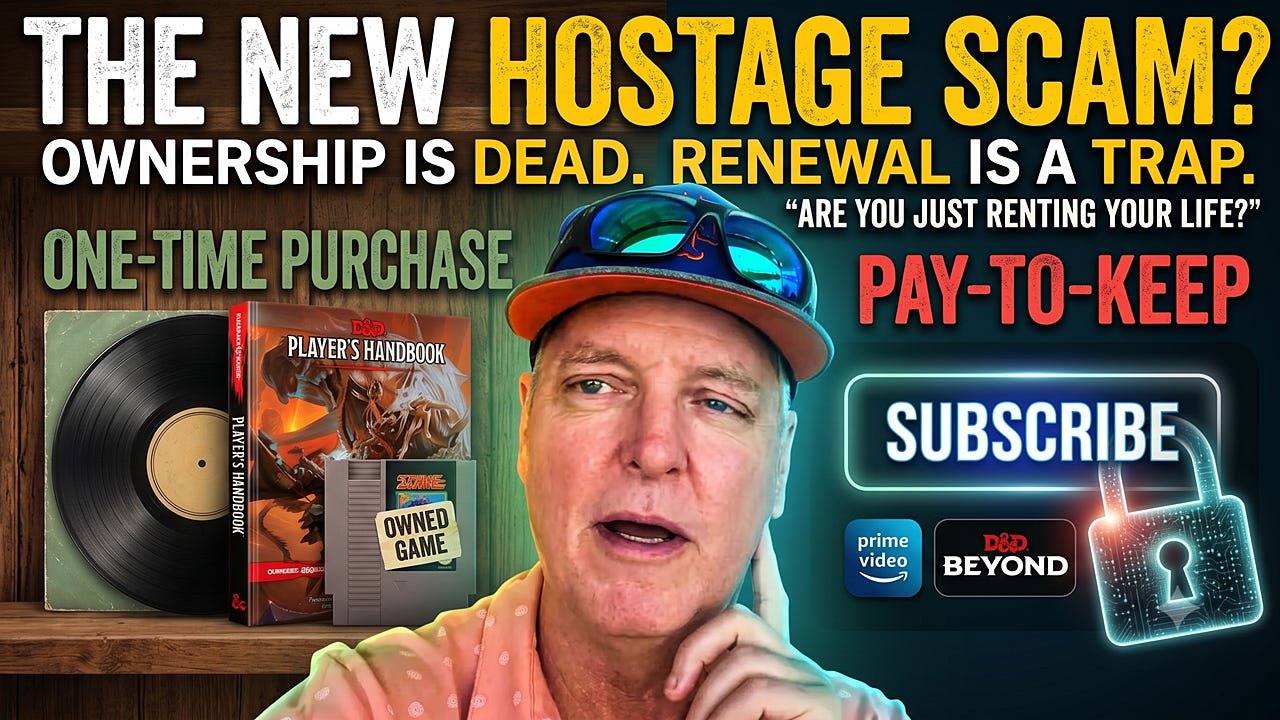
Every industry eventually runs the same test. Sell the thing once, or make people pay to keep it. The format changes each time it happens, records to discs to streams, cartridges to expansions to season passes, hardcover to digital to subscription. The industries never learn from each other because they’re too busy thinking their version is new.
Is it?
f you run a business, you’ve already run some version of this test yourself, whether you called it that or not.
Music ran it first, and ran it in public, so it’s the clearest place to start. The phonograph asked you to buy the record. The CD asked you to buy it again. TheMusic streaming service asked you to stop buying anything and just pay to keep listening.
Three formats, and underneath all three, one question that never changed: are you still getting something worth the money after the sale closes. That’s the same question a customer asks about your product every renewal cycle, they just don’t say it out loud.
Upgrade to paid to unlock the best of this community for you and me. Weekly posts, live videos and honest conversation. Join the VIP circle.
The Gamer in Me
Hearthstone is a card game built by Blizzard, digital only, no physical deck, live for over a decade. It’s useful here for one reason: they can rebalance the entire game any night they choose. New cards, new rules, new reasons to keep playing, pushed out constantly to keep subscribers engaged. Sometimes that kept the game alive and fun. Sometimes they pushed a card so overpowered it broke the balance they’d just built, and the fix became the new problem. That’s the trap for any business that treats “we can just push an update” as a substitute for getting it right the first time. Constant iteration isn’t automatically progress. Sometimes it’s just motion that customers get to absorb the cost of.
Old Skool Gamer in Me
D&D is the current test case, and it’s useful precisely because it’s happening in real time instead of in hindsight. It’s the oldest tabletop role playing game in the world, the kind of game where a group sits around a table with rulebooks and dice, no screen required. Hasbro, who owns it, wants to move players onto a paid digital subscription instead of one-time book purchases.
Old-skool players want the shelf. Everyone’s picking a side in a war that isn’t the real war. I stand against the subscription model, and I’ll say plainly why: it flips the leverage. Buy a book and hate the next one, you just stop buying.
Subscribe to your tools and your ongoing game, then cancel, and you lose access to the thing you already built. That’s not a customer walking away from a bad product. That’s a hostage situation with a monthly invoice, and if you run a subscription business, that’s worth sitting with, because your customers know exactly what it feels like from the other side.
But here’s where it gets uncomfortable, because I think the subscription model might actually be the right way to keep the game alive, and the right model for a lot of businesses too.
A one-time sale means you only have to be good once, on launch day, then you can coast for a decade while the customer keeps using what they already paid for. A subscription means you have to keep earning it every single month, or the cancel button is sitting right there. That should terrify a business into staying sharp. Instead most get lazy and bet the customer won’t bother to leave.
Run the D&D math and the pattern gets sharp enough to hold in one hand, and it’s math any business can run on their own numbers. Three core books, the ones a new player needs to actually play the game, run about a hundred and twenty dollars total. A subscription under ten dollars a month clears that cost in a year. Anyone who stays longer than that comes out ahead in dollars, provided the content stays good. That’s the whole deal in one sentence. Cheap and honest beats expensive and stagnant, and expensive and honest beats cheap and hollow. The number only matters once you know what’s actually behind it. If you’re pricing a subscription right now, that’s the test your price has to pass, not “what can we get away with,” but “does staying longer than a year make the customer glad they didn’t leave.”
None of this was ever about the format. Vinyl versus digital, cartridge versus subscription, hardcover versus platform, they’re all the same test wearing different clothes. Bad content getting paid for anyway is the actual crime, and it happens in every model. The format just decides how fast you find out, and how fast your customer finds out too.
What a lot of newer players, listeners, and customers can’t see is that they’ve never touched the legacy version of anything they use. They came up inside whatever model was already standing, so they have no baseline for what “earning it” used to look like, a record that stayed good for decades, a game that stayed good for years, nobody needing to keep paying just to find that out. They’re not wrong to be inside the new model. They just don’t know there was ever a different standard to measure it against, and that’s exactly the gap a business owner can either exploit or get caught by.
Dragons don’t care which format wins. They care whether the hoard is still worth guarding a year from now.
V> Cheap and honest beats expensive and stagnant, and expensive and honest beats cheap and hollow.